
Bitesuit-work for Schutzhund Dogs
by Armin Winkler
A few weeks ago I got into a bit of a debate with another trainer over the fact that I did bitesuit work with a dog who is destined to be a competitive Schutzhund dog. The accusation was that suit work leads to sloppy gripping technique as well as "dirty" cheap shot behavior in Schutzhund dogs. This debate led me to think a bit about why this misconception exists, and that it might be a good idea to try to clear up some of the wrong impressions people may have. A recent trip to Germany was the final deciding factor for me to write this article for a Schutzhund magazine. I spent a day with a well respected dog training expert. He has been a Schutzhund judge for three different AZG member organizations for 30 years, he has titled countless dogs of 9 different breeds to SchH titles. We discussed my use of the bitesuit in training, and I showed video footage of what I do. He agreed wholeheartedly that this method has merit. So here it goes.
First I would like to clear up a couple of things.
- Suit work is no more personal protection work or civil work than sleeve work is. The dog recognizes this equipment as he does scratchpants and a sleeve.
- Suit work is not just smorgasbord biting, where the dog gets to bite wherever he feels like. Proper targeting needs to be taught just like with a sleeve.
- Suit work is not defense drive work. Even though the dog has to show a bit more than superficial prey desire to do well in this program.
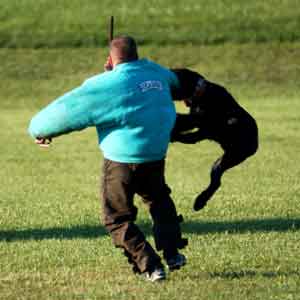 Suit work is not the be all and end all of protection training. It
is also no better than conventional training. It
is simply a step in training which can serve a valuable purpose in teaching some exercises.
Suit work is not the be all and end all of protection training. It
is also no better than conventional training. It
is simply a step in training which can serve a valuable purpose in teaching some exercises.
O.K. with that out of the way a couple of principles I will never let slide when doing this type of work.
- Foundation gripping technique must be taught on a sleeve. The sleeves of today have been specifically designed to foster proper gripping. Also, because of the resistance of a bulky sleeve, technique training on a sleeve will always lead to harder bites.
- Never make a Schutzhund dog do an exercise on a suit for which he did not receive any prior foundation work using a sleeve.
- The target areas I use for Schutzhund dogs are the upper chest and armpit regions. Letting a dog bite there has specific benefits which hopefully will become clear throughout the article.
- Only use people who are experts in a bitesuit, or you will do more harm than good.
The common themes throughout this program will be man-focus, man-awareness, and man-sensitivity. I will be referring to these terms from time to time, so let me explain what I mean by them. Some dogs are so sleeve oriented, they fixate on the sleeve so much, they don't even realize what the helper is doing. These dogs lack man focus. Other dogs have never been worked in defense, maybe because they shouldn't, or maybe because the handler does not want to do that type of work. But then, when the helper does create defense like in a trial, during an attack, the dog sees only the helper, and not the sleeve at all. They are too aware of the helper (the man) and this will lead to problems in some exercises. These dogs have too much man-awareness. And lastly, there are dogs who like to do their work in a way, where they always stay clear of the helper. They avoid contact, they do not commit into the man, and for a lot of them the only reason they are there is the sleeve. Granted, all these problems have a similar root. But they are different from each other. To train through these problems, we don't have to put the dogs through a meat grinder to get it done. Suit work can make the training quite smooth.
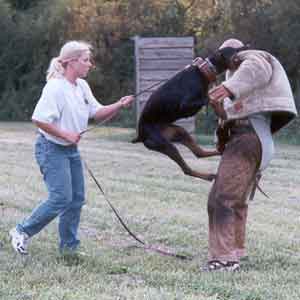 The way I usually get started is to set up a hold and bark situation. The prerequisites here are as I already said, that the dog bites well on a
medium level sleeve, re-gripping behavior is a must. For this exercise, I also want the dog to bark well in close proximity to the decoy. He does
not have to do a perfect hold and bark, but he should be demanding and pushy with the helper, even if the handler still has to help a bit by using
the leash to keep the dog from biting the helper. I set myself up in front of the dog, usually that means that the dog is held on leash, and I work my
way closer to the dog until I am in a hold and bark position. This approaching creates a bit of tension (psychological) between the helper and the dog.
The way I usually get started is to set up a hold and bark situation. The prerequisites here are as I already said, that the dog bites well on a
medium level sleeve, re-gripping behavior is a must. For this exercise, I also want the dog to bark well in close proximity to the decoy. He does
not have to do a perfect hold and bark, but he should be demanding and pushy with the helper, even if the handler still has to help a bit by using
the leash to keep the dog from biting the helper. I set myself up in front of the dog, usually that means that the dog is held on leash, and I work my
way closer to the dog until I am in a hold and bark position. This approaching creates a bit of tension (psychological) between the helper and the dog.
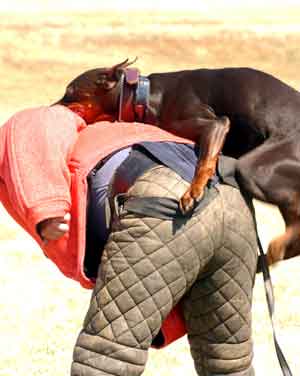
Some dogs act a bit confused at this level, because they do not see a sleeve, only the suit, again this confusion adds a bit more tension. This tension is very good for the hold and bark, it creates intensity. In the beginning I don't stretch this out too long. When the dog is intense and pushy, I spin my whole upper body away. This way, the arms of the suit are not accessible. At the same time, I jerk my shoulder forward just inside the dog's reach. This fast movement, along with the restricted choice of targets, will cause the dog to follow the movement and bite the shoulder (from the back at this stage).
I create some tension on the bite by pulling into the leash. The dog's front legs are off the ground, usually touching me. I make sure the grip is calm, then, I allow the dog to adjust the grip and make sure he ends up with a full, calm grip. (Just because he is biting on a suit, does not mean good grips don't count.) I hold tension for a bit longer and then the handler either pulls the dog off the suit, or I strip the jacket off for the dog as a reinforcement.
The next bite starts exactly the same, except this time I make the dog bite on the other shoulder. I may do a couple of repetitions like that to make the dog comfortable. Then it gets a bit trickier. I once again approach the dog as before. Usually by this time I have accomplished the following things. The dog no longer looks at my arms as the area where the reward comes from, he looks up at me, which makes the hold and bark even nicer. I also have the dog paying attention to my upper body, so targeting becomes a bit easier. So here we are, in the hold and bark position, the dog is barking at me intensely, waiting for me to twitch. Which is exactly what I do, but now without the spin move, instead, I twitch forward the shoulder the dog should bite. Again the movement has to be fast, and exciting so that the dog follows it and bites where I want him to.
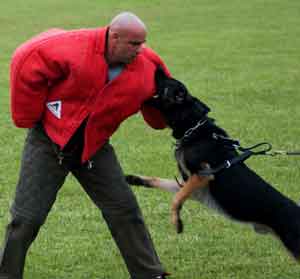 The difficulty here is this. The dog has to come up and commit to the helpers body
(shoulder/chest area), without the helper turning away. This poses considerable psychological difficulties for the dog, so the helper has to be very
careful not to be too strong or overpowering. The dog has to feel as soon as he bites that he has control over the helper. Some tension is necessary
to make sure the bite is hard and calm, but the helper should not look at the dog, or lean over him in a domineering manner. Again, we wait for calmness
in the grip, then allow the dog to re-grip, to ensure a full bite. The jacket should be stripped for the dog as a reinforcement (more advanced dogs can be
pulled off the suit). I don't do a lot of outing off the suit in the early stages, unless a dog has mastered that exercise and does not show signs of stress or
conflict because of it. Again I repeat the exercise on the opposite side.
The difficulty here is this. The dog has to come up and commit to the helpers body
(shoulder/chest area), without the helper turning away. This poses considerable psychological difficulties for the dog, so the helper has to be very
careful not to be too strong or overpowering. The dog has to feel as soon as he bites that he has control over the helper. Some tension is necessary
to make sure the bite is hard and calm, but the helper should not look at the dog, or lean over him in a domineering manner. Again, we wait for calmness
in the grip, then allow the dog to re-grip, to ensure a full bite. The jacket should be stripped for the dog as a reinforcement (more advanced dogs can be
pulled off the suit). I don't do a lot of outing off the suit in the early stages, unless a dog has mastered that exercise and does not show signs of stress or
conflict because of it. Again I repeat the exercise on the opposite side.
The exercise progresses to where the helper challenges the dog more. He pulls the dog up onto his body, he looks at him, he touches him first by petting, then by slapping his sides a bit. As in all the training I do, I make sure the dog learns to deal with some adversity. The positive outcome of sessions like this is that the hold and bark becomes closer, pushier, and generally more intense, also, dogs will not sit in front of the helper and bark at the sleeve. In addition, the dog will gain confidence dealing with the helper as an element, confrontation skills will improve, and the dog will learn to enjoy "fighting" with the helper. The soft and forgiving texture of the suit gives the dog success when biting down harder, which is an instant reward when the dog feels stress. I have decoyed dogs who bark at the sleeve in the blind and who would need extreme harshness to make them so defensive that they would stop that behavior. The same dogs doing a hold and bark on a suit, are intensely focused on the helper and look the way every handler would love to see their dog look. Had these dogs received this type of training when this habit started, it may have never turned into a habit.
The next exercise is a transition exercise, which I have found useful in the past. The pre-requisite here is that the dog in question is capable of biting at least a medium hardness sleeve, and that his bites are consistent and reliable enough, that he can be sent off leash to bite (or at least with a line dragging). To start this exercise, I either do an on leash bite on the suit from the hold and bark, or I do a warm up similar to a sleeve run-by, also on leash. But with a suit on, I do not offer a sleeve, or stick the sleeve closer to the dog, so he can bite, instead, I have to once again use the movement of my shoulder to target the dog to the back of the shoulder, in the shoulder blade area. To do this, I step into the dog's reach, but trigger his attention to my shoulder just before I allow him to make contact. I end up with a bite high up on my shoulder. I let the dog calm down, then re-grip, then I let the dog win the jacket or the handler takes the dog off. Now to the actual exercise, the dog is held by the collar, I stimulate him through movement, maybe I even move close to him and let him miss a bite. Then, I start to move away from the dog, still moving in an exciting fashion, I usually face the dog with the side of my body. On my signal, the handler releases the dog, I let him get to within targeting distance, then I spin around, so my back is facing the dog, at the same time I do a fast, focus triggering shoulder movement, to draw the dog there. The dog connects, and I end up with a bite again high up on my shoulder. I then set the dog's feet on the ground by bending over, I make sure there is enough tension to maintain a calm bite. I can do that by using gravity to help, by erecting myself even slightly, I begin to pull the dog's front off the ground, this is what creates the tension on the bite. I hold the dog like this until the handler shows up and leashes the dog up. I again alternate which shoulder I present, and increase the distance between myself and the dog. I also may keep the dog right up off the ground, as his confidence grows. What the dog learns is that he does not have to only concentrate on the small sleeve, but that a part of the helper's center body mass can also become the target. This will make a dog more confident and less concerned with the sleeve. Let me make a short note here, if a sleeve is in the picture, and the helper presents it properly, there will never be any doubt as to where the dog will bite. This training helps dogs who are dependent on the visible presence of a sleeve to follow through with what their initial drive motivation started. The dogs will commit to the helper in the center, also, the softness of the suit as a target encourages the dogs to really plow into the helper, they get satisfaction from knocking the man around a bit.
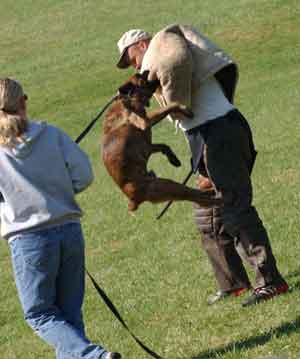 From this transition step, I go on to the next step, which is the frontal attack. Whether it is a courage test,
or an attack from the blind, or from the rear transport,
the technique the dog employs is always the same. It should be a fast, direct, reckless strike through the center of the helper. It is the helper's job to absorb and
catch the dog safely. As helpers, we all have worked dogs who are absolutely determined about coming through on one particular side. If we have no prior
knowledge of the dog, that is a hard catch to make if the dog is fast. Other dogs avoid the helper's body completely, but they jump very fast and very determined
just outside the helper's body range. We can then either reach for them with the sleeve, or let them sail through the air. Or what about dogs who orientate
themselves so much to the sleeve, they are decidedly on one side, slight mistiming by turning a bit early to safely catch the dog results in the dog missing the bite.
This is where a few good sessions in a suit will help. To get started, I give the dog a warm up bite, either from the hold and bark, or I just step into them. This time
I have to employ the frontal shoulder twitch, because I want the dog to bite frontally. So, I step inside the dog's range, and as I do that, I trigger his focus up to
the front of my armpit/chest area, with a fast eye-catching movement of just my shoulder. I let the dog settle and reward him. Then I work on the actual exercise,
which is the frontal strike. Again, I excite the dog, held by the collar, tease him a bit and move a short distance away. When he looks ready, I give the handler
a signal to release the dog. When the dog comes into target distance (we should know where that range is from working the dog off leash with a sleeve prior to
any of these exercises) I throw my shoulder forward, and tuck my arm up, so that my hand is behind the side of my rib cage. The biggest, most eye-catching
movement should again be the shoulder. The dog should follow the trigger movement and strike in the armpit region. What happens some times is that dogs are
not all together comfortable with coming so directly at the helper, and they bite farther outside on the upper arm. That is OK in the beginning, good technique
on the part of the helper should improve that within a few repetitions. Once the dog has made the bite I do what I did during the back shoulder bites, I set the
dog down, to reduce psychological stress, and keep just enough tension on the bite to ensure that it stays calm. Once the handler leashes up the dog, I get a
re-grip, and let the dog win. Again I alternate sides, and gradually increase the distance between decoy and dog. The helpers take quite a pounding during
these exercises, the suit is soft and absorbs the dog's impact. All this leads to confidence improvement in the dog. They like being superior, and take advantage
of this training. One thing which disappears completely is the dependence on the sleeve being presented, and the avoiding the center of the helper.
The dog develops a convincing striking technique. With time, the helper can increase the amount of pressure and confrontation he shows the dog before
and after the bite. But just like in all other training, the dog needs to be challenged in order to improve. The dog always wins and through that he learns that
he can handle anything the decoy confronts him with. Again, the dogs will always take the sleeve when it is there, but that behavior of "Oh no there is a
guy behind that sleeve!" should go away. I finish every suit session with at least one sleeve bite, to see how far the session has taken us,
and also, to give the dog the familiar reward of carrying his prize off the field.
From this transition step, I go on to the next step, which is the frontal attack. Whether it is a courage test,
or an attack from the blind, or from the rear transport,
the technique the dog employs is always the same. It should be a fast, direct, reckless strike through the center of the helper. It is the helper's job to absorb and
catch the dog safely. As helpers, we all have worked dogs who are absolutely determined about coming through on one particular side. If we have no prior
knowledge of the dog, that is a hard catch to make if the dog is fast. Other dogs avoid the helper's body completely, but they jump very fast and very determined
just outside the helper's body range. We can then either reach for them with the sleeve, or let them sail through the air. Or what about dogs who orientate
themselves so much to the sleeve, they are decidedly on one side, slight mistiming by turning a bit early to safely catch the dog results in the dog missing the bite.
This is where a few good sessions in a suit will help. To get started, I give the dog a warm up bite, either from the hold and bark, or I just step into them. This time
I have to employ the frontal shoulder twitch, because I want the dog to bite frontally. So, I step inside the dog's range, and as I do that, I trigger his focus up to
the front of my armpit/chest area, with a fast eye-catching movement of just my shoulder. I let the dog settle and reward him. Then I work on the actual exercise,
which is the frontal strike. Again, I excite the dog, held by the collar, tease him a bit and move a short distance away. When he looks ready, I give the handler
a signal to release the dog. When the dog comes into target distance (we should know where that range is from working the dog off leash with a sleeve prior to
any of these exercises) I throw my shoulder forward, and tuck my arm up, so that my hand is behind the side of my rib cage. The biggest, most eye-catching
movement should again be the shoulder. The dog should follow the trigger movement and strike in the armpit region. What happens some times is that dogs are
not all together comfortable with coming so directly at the helper, and they bite farther outside on the upper arm. That is OK in the beginning, good technique
on the part of the helper should improve that within a few repetitions. Once the dog has made the bite I do what I did during the back shoulder bites, I set the
dog down, to reduce psychological stress, and keep just enough tension on the bite to ensure that it stays calm. Once the handler leashes up the dog, I get a
re-grip, and let the dog win. Again I alternate sides, and gradually increase the distance between decoy and dog. The helpers take quite a pounding during
these exercises, the suit is soft and absorbs the dog's impact. All this leads to confidence improvement in the dog. They like being superior, and take advantage
of this training. One thing which disappears completely is the dependence on the sleeve being presented, and the avoiding the center of the helper.
The dog develops a convincing striking technique. With time, the helper can increase the amount of pressure and confrontation he shows the dog before
and after the bite. But just like in all other training, the dog needs to be challenged in order to improve. The dog always wins and through that he learns that
he can handle anything the decoy confronts him with. Again, the dogs will always take the sleeve when it is there, but that behavior of "Oh no there is a
guy behind that sleeve!" should go away. I finish every suit session with at least one sleeve bite, to see how far the session has taken us,
and also, to give the dog the familiar reward of carrying his prize off the field.
To wrap things up I want to remind people once again that this is only a particular technique, which serves to prepare our dogs for the things they have to face in trials. Bad training in a suit is still bad training, keep that in mind. I felt that this is an interesting subject, and I believe strongly that it is valuable for Schutzhund dogs. Some people share my opinion, and some will not. But if you have the opportunity to work with a really good suit man in a seminar, give some of these suggestions a try, maybe you will see my point. As always thanks for paying attention.
I deliberately omitted an equipment step when I first published this article, as it does not affect the methodology. I would like to briefly explain this step because this re-print of the article will have pictures where the step is shown, and I don't want it to cause any confusion.
 When I prepare young dogs for suit biting, either because the handler may want to include
suit techniques as a way to make their training more complete,
or because the dog is working in one of the suitbiting sports or police, I use a piece of intermediate equipment. This piece of equipment is a soft sleeve that
can be bitten anywhere. My particular version is a replacement sleeve from a bitesuit. ( I am not sure if one of our ingenious equipment manufacturers have
come up with something better yet).
I like this "sleeve," because it can be pushed up all the way to the shoulder and allows biting in the shoulder and armpit regions just like in a suit.
The advantage is that because it is a smaller object it is easier to stimulate the dog's prey drive with it that a complete jacket is.
It also is very easy to strip and reward the dog instantly.
When I prepare young dogs for suit biting, either because the handler may want to include
suit techniques as a way to make their training more complete,
or because the dog is working in one of the suitbiting sports or police, I use a piece of intermediate equipment. This piece of equipment is a soft sleeve that
can be bitten anywhere. My particular version is a replacement sleeve from a bitesuit. ( I am not sure if one of our ingenious equipment manufacturers have
come up with something better yet).
I like this "sleeve," because it can be pushed up all the way to the shoulder and allows biting in the shoulder and armpit regions just like in a suit.
The advantage is that because it is a smaller object it is easier to stimulate the dog's prey drive with it that a complete jacket is.
It also is very easy to strip and reward the dog instantly.
I use it in every way identical to the techniques I described for the bitesuit. For close contact biting as well as running bites, as described above.
Let me explain the downside of this "sleeve." Because the replacement sleeve is attached to the bitesuit jacket at the shoulder, you can well imagine that when a dog does shoulder bites, he is very close to the edge of the "sleeve." It takes careful targeting to make sure the dog in fact targets the "sleeve," and not the bare shoulder. I have had teeth miss the "sleeve" and sink into parts of me on more than one occasion. It is safest used on young dogs. Dogs who are serious and who have undergone some defensive drive promotion are more dangerous and should be worked on a full suit. Dogs are much less object oriented when in defensive drive, and as such do not limit themselves to the "sleeve." And since we want them to bite high during this type of work, we should make sure we have adequate protection in the shoulder area.